


2026 Volkswagen Tiguan vs. 2026 Mazda CX-50: Which SUV Is Right for You?
Compact SUV shoppers in San Juan Capistrano have genuinely strong options right now, and that can actually make the decision harder. Put the 2026 Tiguan and the 2026 Mazda CX-50 side by side and you’re looking at two vehicles with very different personalities. The Tiguan is built around space, comfort, and everyday practicality. The CX-50 is tuned for sport, precision, and a more upscale feel. Neither is a bad pick, but one will almost certainly fit your life better than the other. If you’re already leaning toward the Tiguan, browse our new vehicles at Capistrano Volkswagen to see what’s currently in stock.
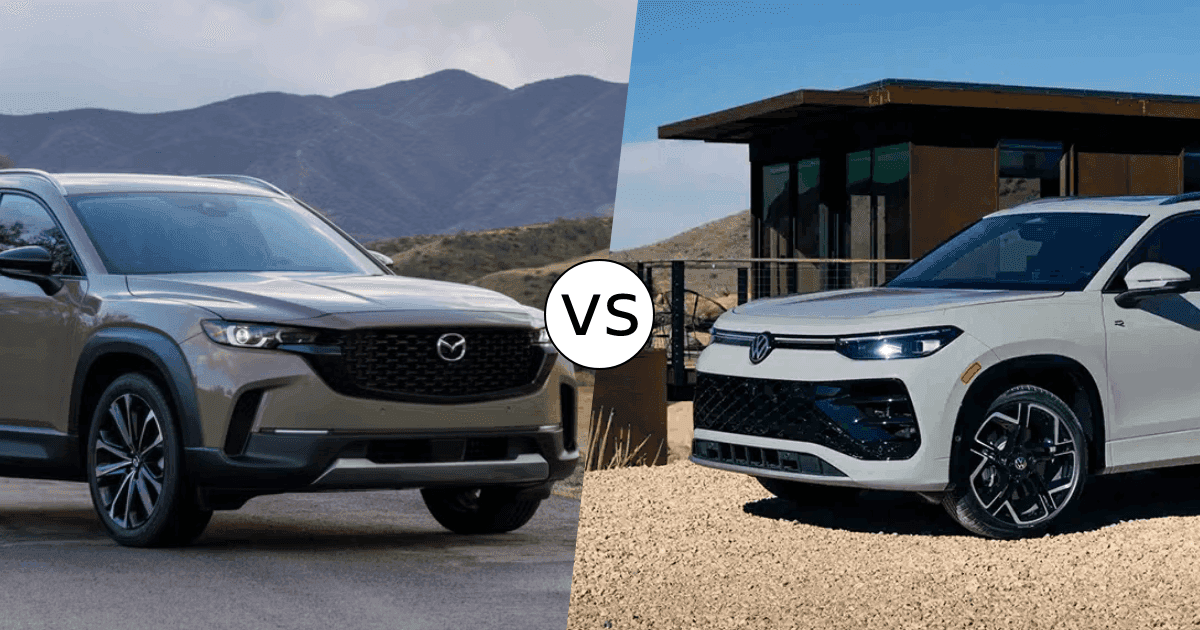
2026 Volkswagen Tiguan vs. 2026 Mazda CX-50: A Side-by-Side Comparison
Volkswagen built the Tiguan around families and daily commuters, prioritizing a generous, well-organized cabin with smooth, unfussy performance. Mazda went a different direction with the CX-50, designing it to feel sporty and upscale, closer to a sport sedan than a typical crossover. Both span multiple trim levels, so buyers can match their preferences without giving up the features they actually care about. The table below captures the core differences at a glance.
| Feature | 2026 VW Tiguan (Base FWD) | 2026 Mazda CX-50 (Base AWD) |
| Engine | 2.0L turbocharged inline-4 | 2.5L naturally aspirated inline-4 |
| Drivetrain | FWD standard, AWD available | AWD standard |
| Transmission | 8-speed automatic | 6-speed automatic |
| Horsepower / Torque | 201 hp / 207 lb-ft (FWD) | 187 hp / 185 lb-ft |
| Fuel Economy (City/Hwy) | 26 / 34 MPG | 24 / 30 MPG |
| Cargo Volume (seats up / folded) | 33.8 / 69.8 cu. ft. | 31.4 / 56.3 cu. ft. |
Powertrain Options and Performance
Performance is where an SUV’s true character comes through. In this matchup, both vehicles use four-cylinder engines and offer all-wheel drive, but they feel noticeably different once you’re actually behind the wheel.
2026 Volkswagen Tiguan: Turbocharged Versatility
The Tiguan runs a 2.0L turbocharged inline-4 producing 201 hp and 207 lb-ft of torque in FWD form, or 201 hp and 221 lb-ft with 4Motion AWD. Drivers wanting more punch can step up to the higher-output variant, which delivers 268 hp and 258 lb-ft. All Tiguan powertrains run on regular unleaded fuel, which keeps ownership costs predictable over time. The 8-speed automatic keeps shifts smooth and unobtrusive. The overall character is composed and confident, clearly tuned for daily comfort rather than track-day aggression.
2026 Mazda CX-50: Sport-Tuned Power and Precision
The CX-50 starts with a 2.5L naturally aspirated inline-4 producing 187 hp and 185 lb-ft, paired with a 6-speed automatic. Mazda also offers an optional 2.5L turbocharged engine that pushes out 256 hp and 320 lb-ft on premium fuel, or 227 hp and 310 lb-ft on regular. A hybrid variant is available too, rated at 219 hp. One meaningful distinction: i-Activ AWD comes standard on every single trim, which sets it apart from the Tiguan’s FWD-standard setup. Sport-tuned suspension and sharper steering give the CX-50 a responsiveness that drivers who enjoy feeling connected to the road will genuinely appreciate.
Fuel Economy: Real-World MPG Comparison
Fuel costs add up fast, and this is an area where the Tiguan holds a real advantage. In FWD configuration, it returns 26 city / 34 highway / 29 combined MPG. With 4Motion AWD, those figures shift to roughly 22 city / 29 highway / 25 combined. The base CX-50 returns 24 city / 30 highway / 26 combined, and the turbo drops to 23 city / 29 highway / 25 combined. Worth noting for efficiency-focused buyers: the CX-50’s hybrid variant leads the class at 39 city / 37 highway / 38 combined MPG.
On range, the Tiguan’s 14.5-gallon tank delivers an estimated 493-mile highway range in FWD trim. The CX-50 carries a larger 15.9-gallon tank, but its estimated highway range comes in at around 477 miles on the base engine.
Interior Quality, Passenger Space, and Cargo Room
Step inside either of these SUVs and you’ll find a cabin that reflects real effort. Where they diverge is in focus: the Tiguan prioritizes space and usability, while the CX-50 leans into material quality and atmosphere.
Cabin Materials and Comfort Features
The Tiguan’s interior is designed with durability and function at the forefront. Controls are logically placed, surfaces hold up well over time, and the rear seats offer recline and slide functions that genuinely help accommodate passengers of different sizes. The CX-50 takes a more premium approach, using higher-grade materials and a more considered visual design. That difference in feel is noticeable, particularly on upper trims where Bose audio is available. If interior ambiance matters to your daily experience, the CX-50 has the edge in craftsmanship. If ease of use and long-term practicality rank higher, the Tiguan’s layout is hard to argue with.
Rear Passenger Room and Cargo Capacity
This is where the comparison gets most relevant for families. The Tiguan offers 33.8 cu. ft. of cargo space with seats up and 69.8 cu. ft. with the rear seats folded. The CX-50 comes in at 31.4 cu. ft. with seats up and 56.3 cu. ft. folded. Buyers who regularly need to seat adults in the back or haul substantial cargo will find the Tiguan more accommodating. The CX-50 isn’t cramped by any stretch, but the numbers tell a clear story. To see the Tiguan’s interior in person, feel free to contact us and schedule a visit.
Technology, Infotainment, and Safety Features
Both SUVs bring capable, modern tech packages. The key question is whether you prefer a large, intuitive touchscreen or a more tactile interface built around a rotary knob.
Infotainment and Connectivity
The Tiguan comes standard with a 12-inch touchscreen, wireless Apple CarPlay, and Android Auto, with an optional 15-inch display on higher trims. The CX-50 uses a 10.25-inch display with wireless connectivity, controlled through a rotary knob that drivers who prefer tactile inputs tend to like. Bose audio is also available on upper CX-50 trims. Both systems handle the essentials well; the difference really comes down to how you want to interact with your infotainment while driving.
Driver Assistance and Safety Tech
Volkswagen’s IQ.DRIVE suite comes standard on the Tiguan, covering adaptive cruise control, lane-keeping assist, blind-spot monitoring, and automatic emergency braking. The CX-50 also includes a solid standard safety package: blind-spot monitoring, rear cross-traffic alert, adaptive cruise control, and a driver alert monitor that detects fatigue, which is something the Tiguan doesn’t offer. Both vehicles take active safety seriously, and either one is a credible choice for buyers who prioritize ADAS coverage.
What the 2026 Tiguan Does Best
The Tiguan is built for real life in the most practical sense. Five features stand out:
- Superior base fuel economy, up to 34 highway MPG in FWD trim
- Larger cargo capacity, up to 69.8 cu. ft. with seats folded
- Runs on regular unleaded across all powertrains, including the higher-output variant
- Spacious rear seats with recline and slide functions for genuine adult comfort
- Higher-output engine option producing 268 hp and 258 lb-ft for drivers who want more power
For families, commuters, and anyone who needs their vehicle to work well without drama, the Tiguan delivers consistently.
What the 2026 Mazda CX-50 Does Best
The CX-50 earns its place in this comparison on its own merits. Seven features make a compelling case:
- Standard i-Activ AWD on every trim, with no upgrade required
- Higher turbo torque output, up to 320 lb-ft on premium fuel
- Greater ground clearance at 8.6 inches for light off-road capability
- Driver alert monitor for fatigue detection, a genuine safety differentiator
- Sport-tuned handling through i-Activ AWD for a more engaging drive
- Larger 15.9-gallon fuel tank for fewer fill-up stops
- Hybrid option available at 38 combined MPG for efficiency-focused buyers
Buyers who want both performance and refinement in the same package will find the CX-50 a genuinely strong choice.
Which SUV Is Right for You, and Where to Find It
Choosing between these two really comes down to what you value most in your daily drive. Here’s how we’d break it down for San Juan Capistrano shoppers:
- Families prioritizing cargo room and fuel savings will find the Tiguan’s 69.8 cu. ft. of cargo space and 34 highway MPG hard to beat.
- Drivers who want AWD included without upgrading trims will appreciate that the CX-50 makes i-Activ AWD standard across the lineup.
- Commuters focused on highway efficiency will get the most from the Tiguan FWD, which leads this comparison at 34 highway MPG.
- Drivers who want an available hybrid powertrain will find the CX-50’s 38 combined MPG hybrid option compelling.
If the Tiguan fits your priorities, explore our 2026 Tiguan inventory and schedule a test drive at Capistrano Volkswagen. If the CX-50 sounds more like your match, Capistrano Mazda is right next door and can put you behind the wheel the same day. Either way, you’re choosing a well-built SUV. The right one is simply the one that fits how you actually live.
0 comment(s) so far on 2026 Volkswagen Tiguan vs. 2026 Mazda CX-50: Which SUV Is Right for You?