


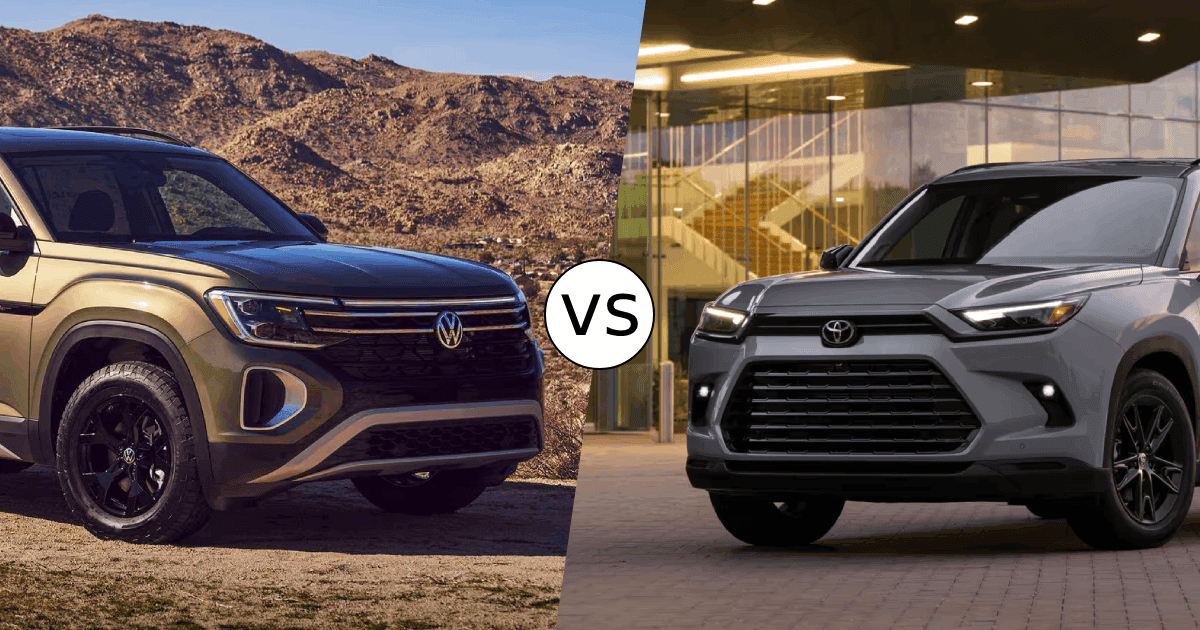
2026 Volkswagen Atlas vs. 2026 Toyota Grand Highlander
Shopping for a three-row SUV that genuinely works for your family is harder than it sounds. The segment is crowded, spec sheets blur together, and dealers will tell you their vehicle is the best regardless. When comparing the 2026 VW Atlas vs. Toyota Grand Highlander, it helps to cut through the noise and focus on real-world space, comfort, performance, and the features your family will actually use. We invite you to browse our new Volkswagen Atlas inventory and see how the 2026 lineup stacks up for yourself.
These two SUVs represent very different philosophies about what a modern family hauler should be. The Atlas leans into generous proportions, driver-friendly dynamics, and a straightforward ownership experience. The Grand Highlander takes a more refined approach, with interior quality and powertrain efficiency as its main calling cards. Both are legitimate contenders, but only one is likely to fit your specific life.
A Tale of Two Three-Row SUVs: Setting the Stage
The demand for spacious, capable three-row SUVs hasn’t slowed down. Families need real seating for real passengers, cargo space that can handle a Costco run and a weekend camping trip simultaneously, and enough technology to keep everyone connected without making the driver feel like they’re piloting a spacecraft.
The Volkswagen Atlas has built its reputation on exactly that kind of practical, no-nonsense approach. It’s long been recognized for having one of the most genuinely usable third rows in the segment, which matters enormously once you’re loading teenagers into the back. The Toyota Grand Highlander was built for buyers who felt the standard Highlander was simply too small, aimed at families who want luxury touches alongside cargo capacity.
A proper side-by-side comparison between these two reveals a lot. They’re close in price, close in size, and close in feature content, but the details are where things get worth talking about.
2026 Volkswagen Atlas: Trims, Features, and What Sets It Apart
The Atlas lineup for 2026 is thoughtfully tiered, giving buyers a clear path from an accessible entry point up to a fully loaded flagship. Even the base trim doesn’t feel bare. Volkswagen includes a meaningful standard feature set across the entire Atlas range, including IQ.DRIVE on every trim. IQ.DRIVE bundles Travel Assist, Adaptive Cruise Control, Active Blind-Spot Monitor, Front Assist, Rear Traffic Alert, Emergency Assist, and Lane Assist, so you’re never paying for an SEL just to get basic safety tech.
The Atlas also carries forward its signature interior proportions. The second and third rows are designed to actually accommodate adults, not just fold flat for cargo when nobody’s using them.
SE
The SE is where the Atlas story begins, and it starts from a solid foundation. You get comfortable seating for up to seven, a capable infotainment system, and a clean, intuitive interior layout that Volkswagen does particularly well. For budget-conscious families who want real value without stripping out the essentials, the SE delivers.
SE with Technology
Step up to the SE with Technology and the daily driving experience gets noticeably sharper. This trim adds connectivity upgrades and enhanced driver-assistance features that make commuting and school-run logistics feel more manageable. It’s the trim that makes the most sense for families who spend a lot of time in the car and want technology working in their favor.
Peak Edition
The Peak Edition is purpose-built for buyers who don’t want to choose between a family hauler and something capable on varied terrain. It brings rugged styling upgrades and better off-pavement capability, making it a strong choice if weekend adventures are as common as weekday errands. Within this segment, the Peak Edition occupies a fairly unique space.
SEL
The SEL trim shifts the Atlas into genuine comfort territory. Upgraded materials and added convenience features make long drives significantly more pleasant for everyone on board. If you’re moving up from a smaller SUV and want to feel the difference in quality, the SEL is where that shift becomes tangible.
SEL Premium R-Line
The SEL Premium R-Line is the Atlas at its absolute best. Premium audio and high-end interior finishes pair with the full roster of advanced technologies in a package that genuinely competes with near-luxury alternatives. For buyers evaluating options at this price point, the SEL Premium R-Line holds its own impressively well.
2026 Toyota Grand Highlander: Highlights and Key Features
Toyota’s Grand Highlander makes a clear statement: bigger is better. The 2026 model continues refining that mission with a modern infotainment interface, quality interior materials, and Toyota Safety Sense 3.0. This includes pedestrian-focused collision mitigation, automatic emergency braking, adaptive cruise control, lane departure warning, lane-centering steering, and automatic high beams, among other features.
One of the Grand Highlander’s strongest selling points is its hybrid powertrain option, which pairs performance with efficiency in a way that appeals strongly to cost-conscious buyers. The interior is well-finished, and the second-row experience gets consistently good reviews from owners. Toyota has also improved third-row accessibility compared to earlier generations.
Interior Space, Comfort, and Family Livability
This is where the Atlas vs. Grand Highlander conversation gets worth paying close attention to. The Atlas has a well-earned reputation for its third row. Unlike many competitors that treat the third row as a compliance feature, Volkswagen designed the Atlas so that adults can sit back there without feeling punished. For larger families or anyone who regularly travels with more than five people, that distinction is significant.
The Grand Highlander focuses more on the second-row experience, with premium materials and thoughtful ergonomics. It also offers standard seating for eight passengers, with an optional seven-passenger configuration via second-row captain’s chairs. The third row has improved over previous generations, but taller passengers may still find it less accommodating than the Atlas equivalent. Cargo space is competitive between the two, with both offering solid capacity for family gear and travel luggage.
When comparing interior volume, the Atlas consistently shows its dimensional advantage in third-row headroom and legroom. For families with older children or regular adult passengers in the rear, this side-by-side comparison lands clearly in the Atlas’s favor.
Performance, Powertrain, and Real-World Driving
The 2026 Atlas runs a 2.0-liter turbocharged four-cylinder producing 269 hp and 273 lb-ft of torque, paired with an eight-speed automatic transmission. FWD is standard, with AWD available. EPA-estimated fuel economy comes in at 20 mpg city, 27 mpg highway, and 23 mpg combined, with a towing capacity of up to 5,000 lbs when properly equipped. Merging onto the freeway, passing on a highway, or carrying a full load of passengers and gear all feel effortless, and the Atlas’s composed, predictable handling is a genuine pleasure for families on the roads around San Juan Capistrano, CA.
The Grand Highlander’s gas engine produces 265 hp, with EPA estimates of 21 mpg city, 28 mpg highway, and 24 mpg combined, and matching towing capacity of up to 5,000 lbs when properly equipped. Its standout feature is the available hybrid powertrain. For buyers who cover high annual mileage, that efficiency edge can translate into real savings over time. In non-hybrid gas configuration, the performance gap narrows considerably, and the Atlas’s output and driving dynamics become more apparent.
Buyers who prioritize driving enjoyment will find the Atlas more satisfying; those with high annual mileage who want to maximize fuel savings will find the Grand Highlander hybrid makes a strong case.
Technology, Safety, and Driver Assistance Features
Both vehicles arrive with modern infotainment systems that support wireless smartphone integration and intuitive interfaces. The Atlas distinguishes itself with a larger touchscreen and Digital Cockpit Pro, which give drivers more direct control over how they interact with the vehicle’s systems. It feels cohesive rather than feature-heavy for its own sake.
The Grand Highlander counters with a well-designed interface that prioritizes accessibility and ease of use. In certain advanced safety categories, including pedestrian detection and collision avoidance through Toyota Safety Sense 3.0, it has an edge that safety-first buyers will appreciate.
Having IQ.DRIVE standard across all Atlas trims is a meaningful differentiator at every price point. You don’t have to climb the trim ladder to access solid driver-assistance features, which makes the Atlas a stronger value for safety-conscious buyers.
We encourage families considering either vehicle to contact our team in San Juan Capistrano to schedule a side-by-side test drive and see the technology differences firsthand.
2026 VW Atlas vs. 2026 Toyota Grand Highlander: The Verdict
Running the full comparison, these two SUVs serve different buyers, and picking the right one comes down to being honest about how your family actually uses a vehicle.
Why the Atlas Earns the Edge for Most Buyers
For the majority of families doing this side-by-side comparison, the 2026 Volkswagen Atlas earns the recommendation. Third-row usability is where it genuinely pulls ahead. The driving experience is enjoyable and well-sorted; IQ.DRIVE is standard on every trim; and the tiered lineup lets buyers start at an accessible price without giving up the fundamentals. Pricing is subject to change, so we recommend reaching out to confirm current figures.
To explore the full 2026 Atlas lineup, browse our new Volkswagen Atlas inventory or contact our team in San Juan Capistrano to schedule a visit.
When the Grand Highlander Makes More Sense
The Grand Highlander makes a strong case for buyers who prioritize hybrid efficiency and expect high annual mileage where fuel savings add up meaningfully. It’s also a good fit for buyers who weight second-row comfort and a premium interior feel above third-row practicality, or those for whom Toyota Safety Sense 3.0’s pedestrian safety systems are a decisive factor. If your household rarely uses the third row and the hybrid’s long-term economics align with your driving habits, the Grand Highlander deserves serious consideration.
For everyone else, particularly families shopping for a three-row SUV where all three rows actually get used, the 2026 VW Atlas is the stronger, smarter choice.
0 comment(s) so far on 2026 Volkswagen Atlas vs. 2026 Toyota Grand Highlander