


2025 Volkswagen Atlas Cross Sport vs. Jeep Grand Cherokee
If you’re thinking of purchasing a midsize SUV, you’re probably considering two popular contenders that fill spots at dealership lots nationwide: the Volkswagen Atlas Cross Sport and the Jeep Grand Cherokee. Here at Capistrano Volkswagen in California, we’ve put together this no-nonsense comparison to help you figure out which one best fits your daily driving needs, family requirements, and budget.
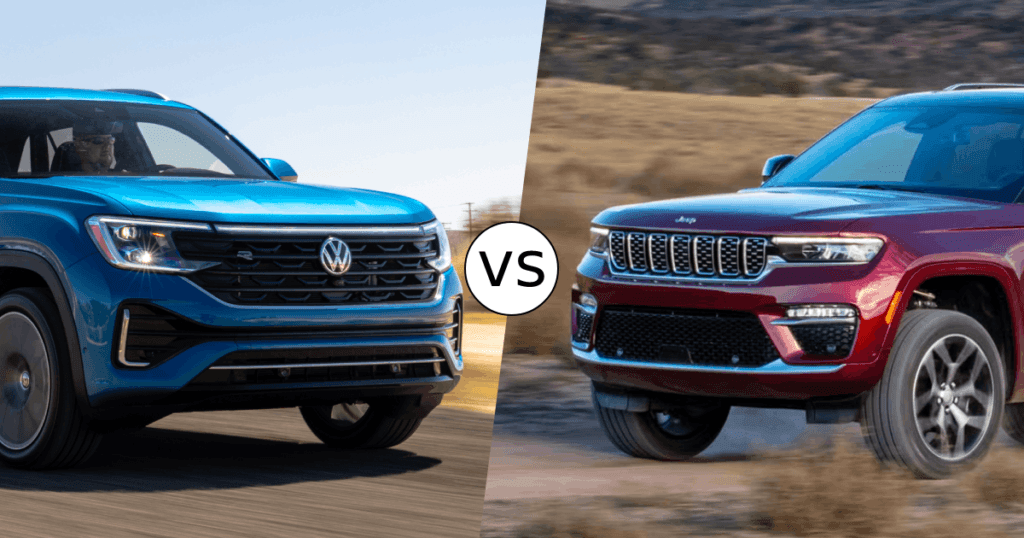 Overview of the 2025 Volkswagen Atlas Cross Sport and Jeep Grand Cherokee
Volkswagen completely revamped the Atlas Cross Sport for 2024, so the 2025 model sees only minor updates. The biggest change is the addition of a new SEL R-Line Black trim, joining the existing lineup of the SE, SE with Technology, SEL, and SEL Premium R-Line. Similarly, the 2025 Jeep Grand Cherokee carries over from 2024 with no major updates, continuing to offer Jeep’s traditional SUV styling with added comfort. Both vehicles cater to families looking for practical, versatile transportation.
Design and Aesthetics
The Atlas Cross Sport features bold styling with a sizable grille, LED headlights, and an available illuminated light bar and emblem. Wheel options range from 18 to 21 inches, and available features include a panoramic sunroof and roof rails. It appeals to buyers who want their vehicle to stand out.
The Grand Cherokee maintains a confident profile on the road with its LED headlights and taillights, panoramic sunroof, and available power liftgate. Its iconic seven-slot grille and upright stance make it immediately recognisable.
Performance and Capability
Every Atlas Cross Sport comes with a turbocharged 2.0-liter four-cylinder engine producing 269 horsepower and 273 lb-ft of torque. It pairs with a smooth eight-speed automatic transmission and a choice of front-wheel or all-wheel drive.
The Grand Cherokee comes with a 3.6-liter V-6 engine producing 293 horsepower and 260 lb-ft of torque. Volkswagen’s eight-speed automatic transmission includes Tiptronic for manual shift control when needed.
Off-Road Capability
The Atlas Cross Sport comes standard with front-wheel drive, but you can add Volkswagen’s 4MOTION all-wheel-drive system, which intelligently predicts wheel spin and stops it before it happens. Front-wheel-drive models give you Eco, Comfort, Sport, Snow, and Custom driving modes, while 4MOTION versions add an Off-Road mode too. This setup is capable enough to handle most real-world driving scenarios, including slick winter roads and dirt trails.
In contrast, the Grand Cherokee brings some serious off-road credentials with its choice of three advanced four-wheel-drive (4WD) systems: Quadra-Trac, Quadra-Trac II, and Quadra-Drive II. These give you higher ground clearance and grip snow and ice better than Volkswagen’s 4MOTION system. Towing is another area where the Jeep excels. The Grand Cherokee can tow up to 6,200 pounds when properly equipped. The Atlas Cross Sport, meanwhile, has a maximum towing capacity of 5,000 pounds, which is still pretty good for its class.
Technological Features
Every Atlas Cross Sport comes equipped with a 12-inch touch screen and a 10.25-inch digital display, providing four layout options and full-screen navigation maps. The clear display enables easy information access at a glance. Standard features include wireless phone charging and four USB-C ports, while a 12-speaker Harman Kardon premium audio system comes standard with the top-of-the-range SEL Premium R-Line.
Meanwhile, the Grand Cherokee offers wireless Apple CarPlay and Android Auto, an 8.4-inch Uconnect 5 touch-screen display, and 10.25-inch digital gauges. Premium trims feature a 10.1-inch screen as standard, along with an optional 19-speaker McIntosh audio system and a passenger display.
Interior Comfort and Cargo Capacity
Both SUVs seat five, but the Atlas Cross Sport offers more space. Volkswagen provides 41.7 inches of front legroom versus Jeep’s 41.3 inches, while the difference in the rear is more pronounced — the Atlas Cross Sport delivers 40.4 inches while the Grand Cherokee manages just 38.2 inches. This extra room can make a big difference on long trips.
The Volkswagen also leads when it comes to cargo space, offering 40.3 cubic feet behind the rear seats and 77.6 cubic feet with the seats folded. In comparison, the Grand Cherokee provides 37.7 cubic feet behind the front seats, expanding to a maximum of 70.8 cubic feet. That’s nearly seven cubic feet less than the Volkswagen.
Fuel Economy
The Atlas Cross Sport achieves an EPA-estimated 20 mpg in the city and 27 mpg on the highway. The Grand Cherokee manages 26 mpg on the highway but drops to 19 mpg in the city. While it’s a small difference, that extra mile per gallon in city driving can be significant for urban commuters. With its better city fuel economy, the Atlas Cross Sport is a more efficient choice for urban drivers who frequently encounter stop-and-go traffic.
Pricing
The starting prices for both SUVs are pretty similar, $37,190 for the Atlas Cross Sport versus $36,495 for the Grand Cherokee, so budget-conscious shoppers are unlikely to notice much difference. However, the pricing for high-end trims differs considerably. The Atlas Cross Sport tops out around $52,195, while the top-tier Grand Cherokee Summit Reserve reaches $63,040 — over $10,000 more.
Which SUV Is Right for You?
The Atlas Cross Sport delivers better value for daily family use, excelling in terms of cargo space, rear legroom, and city fuel economy. Its competitive pricing and premium features make it a smart choice. In contrast, the Grand Cherokee excels at towing, off-road performance, and 4WD capability. Heavy towers and outdoor adventurers might prefer the Jeep, but for families focused on daily practicality, the Atlas Cross Sport offers more useful features.
0 comment(s) so far on 2025 Volkswagen Atlas Cross Sport vs. Jeep Grand Cherokee